Blitzscaling gets quoted at me more often than any other business book. Usually by people who have read the title and one summary thread.
It comes up in the same shape every time. A founder or a sponsor wants to move faster than the evidence supports, and reaches for the word as cover. We need to blitzscale this. What they mean is: let’s spend before we know, and call the risk a strategy.
That is not what the book says. Read properly, Blitzscaling is one of the most disciplined pieces of writing on growth I have come across, because most of it is about when you are not allowed to do it. The framework’s real output is a decision, and the decision is usually no.
I have built and backed enough ventures now — enterprise software, a compliance platform, a services marketplace, transit-screen media, agribusiness — to have tested the framework against markets Hoffman never had in mind. Here is what holds, what breaks, and what I run instead.
What the book actually argues
Blitzscaling is Hoffman and Yeh’s term for deliberately prioritising speed over efficiency under uncertainty. Not speed because you are impatient. Speed because in a specific class of market, the first company to reach scale takes a position nobody can later buy back, and the waste you incur getting there is cheaper than the position you lose by being second.
The structure is straightforward:
- Three techniques — business model innovation, strategy innovation, management innovation. The last one is where most companies fail, and it is the most useful third of the book.
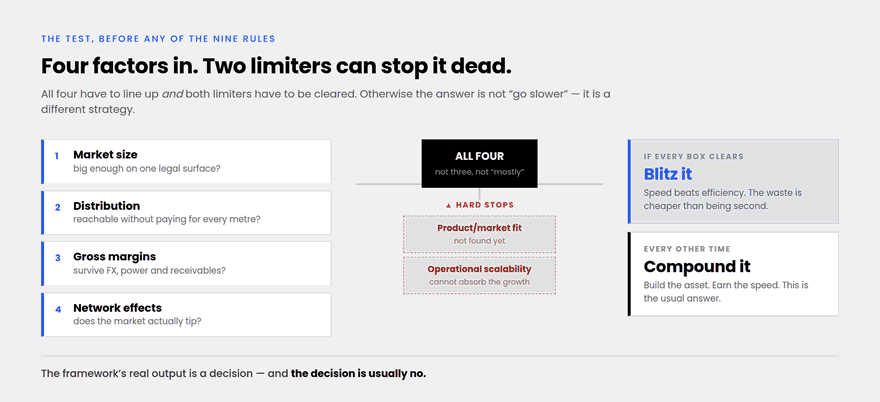
- Four growth factors — market size, distribution, high gross margins, network effects. These are what make a business capable of blitzscaling.
- Two growth limiters — lack of product/market fit, and operational scalability. These are what stop it dead regardless of ambition.
- Five stages, sized by headcount — family, tribe, village, city, nation. Each stage breaks the management model that worked in the one before it.
- Nine counterintuitive rules — embrace chaos, hire for now rather than forever, tolerate imperfect management, ship something that embarrasses you, let fires burn, do things that don’t scale, ignore your customers, raise too much money, evolve your culture.
The last section, on responsible blitzscaling, is the part reviewers skip and the part that has aged best. Hoffman is explicit that speed externalises cost onto customers, staff and society, and that the founder owns that bill.
The book’s own test comes first, before any of the rules: do the four factors line up, and are the two limiters cleared? If not, blitzscaling is not a brave choice. It is just burn.
That test is the thing I use. The rest is commentary.
Where I actually use it
1. As a go/no-go filter before I put money or a team behind anything
I run the four factors across every venture before it gets funded or staffed. Not as a pitch exercise — as an honest scorecard, written down, with the weak boxes named. Here is roughly how three of mine sit against each other:
| Growth factor | Compliance platform regulated FIs |
Services marketplace | Agri-processing & export |
|---|---|---|---|
| Market size | Narrow but deep — every licensed institution in the region is obligated to buy something | Very large informal labour market, thin monetisable slice | Large and structurally growing food demand, but bounded by processing capacity |
| Distribution | Relationship and regulator-led. Slow, high-trust, hard to copy | Mobile and word of mouth. Cheap to reach, expensive to make trusted | Physical, capital-heavy, route by route |
| Gross margins | Software margins. Strong | Take-rate margins. Thin, pressured by cash handling | Commodity margins, exposed to input and FX swings |
| Network effects | Weak on its own. Real only if institutions share risk signals | Genuine two-sided effects, locally dense | None |
| Verdict | Compound it. Do not blitz it | Blitz-capable if the trust layer is solved first | Never blitz. Build the asset |
Three businesses I believe in equally. One growth strategy each, and they are not the same strategy. Confusing them is how portfolios die — you apply marketplace tactics to an asset business and wonder why the cash never comes back.
The most valuable thing Blitzscaling has done for me is give me a defensible vocabulary for saying this one compounds, it does not blitz, to a board, a partner, or myself at 2am.
2. As an org design tool, stage by stage
The five stages are the part I use most operationally, because they name a failure I have watched repeatedly: hiring an executive built for a company four stages ahead of the one you have.
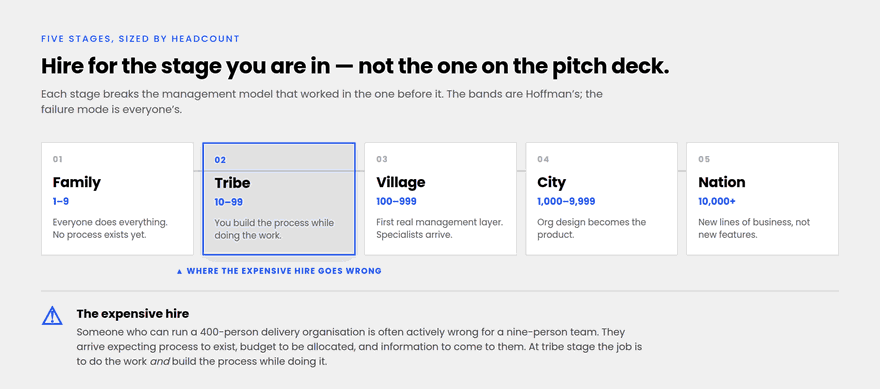
The person who can run a 400-person delivery organisation is often actively wrong for a nine-person team. They arrive expecting process to exist, budget to be allocated, and information to come to them. In a tribe-stage company, the job is to do the work and build the process while doing it.
So I hire for the stage I am in, say so out loud in the offer conversation, and design the role to be outgrown. That is Hoffman’s “hire Ms. Right Now” rule, and in our market it has a second benefit: it is honest about a real constraint instead of over-promising a title we cannot yet fund.
The same logic drives how I structure dedicated delivery teams for clients. A team’s shape should match the stage of the product it is serving, not the stage of the client’s letterhead.
3. As permission to let fires burn — which is really portfolio triage
Across several ventures at once, something is always on fire. The rule that matters is not ignore problems. It is: rank the fires, and be explicit about which ones you are choosing to let burn this quarter.
The discipline is in writing the list down. An unwritten decision to neglect something is just neglect. A written one is a strategy with an owner and a review date. When a fire I chose to let burn flares up, I do not get to act surprised — I get to check whether the ranking was wrong.
4. Doing things that don’t scale — except here, that is the moat
Hoffman frames unscalable work as a temporary phase you graduate from. In West Africa I would put it differently.
The unscalable work often is the durable advantage. Field agents. Cash reconciliation. USSD flows for feature phones. Sitting inside a client’s office for three weeks to learn how custody of a document actually moves between departments before a single line of code is written.
A competitor with better capital can copy your interface in a quarter. They cannot copy four years of learning how a Ghanaian institution actually approves things. In markets where infrastructure is thin and trust is earned slowly, the manual layer is not a phase to escape. It is the part you industrialise and keep.
5. Shipping something that embarrasses you — with one hard exception
I believe in this rule for consumer and SME products. Ship early, be embarrassed, learn.
It does not transfer to institutional and government work, and pretending it does is how firms lose a sector. In enterprise and public-sector delivery you get one first impression, it is made in a room with twelve people in it, and it is permanent. A buggy demo does not read as scrappy. It reads as these people cannot be trusted with our data.
So the embarrassing version still gets built — it just never leaves the building. It goes to an internal pilot or a design partner under a proper agreement, where the mess is contained and the learning is identical. Same rule, different blast radius.
Where the book breaks
Now the harder half.
It assumes fuel. Blitzscaling is financed scaling. “Raise too much money” is sound advice in an ecosystem where too much money exists to be raised. Across most of this continent, the capital available at the relevant stage is a rounding error against what the book’s case studies consumed. You cannot out-raise a competitor when neither of you can raise. So the strategy must change, not just the pace.
Its market-size test punishes fragmentation. A single West African country is rarely a blitzscale-sized market on its own. The region is, but it is fifteen regulatory regimes, several currencies, and different payment rails. Scale here is not one curve. It is a series of standing starts, each with its own licensing conversation. The book’s growth curves assume one legal surface. We do not have one.
Distribution is physical and it is expensive. Viral, zero-cost distribution assumes ubiquitous connectivity, app-store habits and payment cards. Real distribution here runs through agents, telcos, associations, churches, market queens and regulators. It works, it is defensible, and it is nothing like free.
Margins leak in places the book never models. Software margins look pristine until you account for payment processing, FX exposure, power redundancy, and the receivables cycle of institutional clients. A 90% gross margin on paper can behave like 55% in cash.
And winner-take-all is not the default shape. Hoffman’s framework assumes markets that tip. Many of ours do not — they are regulated, relationship-bound, and structurally plural. Being second into a market with the better compliance posture and the stronger institutional relationship is frequently the winning position.
None of this makes the book wrong. It makes it conditional, which is exactly what it claims to be. The failure mode is not the book. It is founders importing conclusions drawn from conditions they do not have.
What I run instead
Five working rules, in the spirit of the original but rebuilt for the market I operate in:
1. Earn your speed. If you cannot raise the blitz, fund it. Services revenue, consulting, delivery contracts — cash that pays for product development without dilution. It is slower and less glamorous than a round. It also means no external clock decides when your product is allowed to be wrong.
2. Blitz the learning curve, not the burn rate. Speed is the goal, but the variable to maximise is cycles of validated learning per quarter, not spend per month. Those two get confused constantly, and they are not the same number.
3. Make the unscalable thing the moat. Identify the manual, relational, local work that a better-funded competitor cannot shortcut. Then systematise it rather than eliminating it.
4. Scale trust before you scale users. In regulated and low-institutional-trust markets, identity, compliance and data governance are not a tax on growth. They are the growth factor — the equivalent of a network effect, because trust compounds and does not transfer to a new entrant.
5. Rank your fires in writing. One page, every quarter, naming what you are choosing not to fix. Sign it. Review it.
The verdict
Read it. Read it as a diagnostic, not a doctrine.
The four factors and two limiters are the best single-page test I know for deciding whether a business is structurally capable of the growth its founder is describing in the pitch. The stages and transitions will save you at least one bad executive hire. The nine rules are worth arguing with, because roughly half of them invert in a capital-scarce, fragmented, relationship-driven market, and working out which half tells you a great deal about your own business.
What the book will not do is tell you whether you should. That is a judgement about your market, your balance sheet and your temperament, and no framework outsources it.
Pair it with Christensen’s The Prosperity Paradox for the view from markets that have to be created rather than captured. Between them you get the honest picture: some businesses are built to blitz, most are built to compound, and the expensive mistake is treating one as the other.
I have made that mistake. Once is educational.